

On-site catering means the food and drinks for your event are prepared and served at the venue itself, by a team that works in the space you have booked. Nothing is driven in from a distant kitchen. The menu, the service staff and the setup of the room are planned together, so you deal with one plan instead of several suppliers. Below you will find how it works, how it differs from off-site catering, what to settle before you sign, and how to give a menu a true Apulian accent.
TL;DR
- On-site catering is cooked and served where the event takes place. Off-site catering is prepared elsewhere and transported.
- A good service covers menu selection, a venue visit, preparation, table setup, service and cleanup, with one person coordinating the staff.
- Settle the menu, final guest count, staffing hours, payment terms, VAT and service charge in writing, and collect dietary needs early.
- For rehearsal dinners, pre-wedding parties, birthdays and baptisms, a venue that hosts and caters in the same garden keeps things simple.
- In Puglia, build the menu around the season and the territory: orecchiette, burrata, local vegetables, olive oil and fish.
Table of Contents
- What on-site catering means
- How on-site catering works, step by step
- Which events suit on-site catering
- What to settle before you book
- Why the space matters as much as the menu
- Building an Apulian menu
- Perspective
- Plan your event with us
- Questions people ask about on-site catering
- Sources
What on-site catering means
The simplest way to understand it is by contrast. Italian municipal rules describe catering as food and beverage service prepared away from the premises where it is served and moved there by vehicle, for occasions such as weddings, baptisms, anniversaries and public events. The Reggio Emilia hygiene regulation of 2024 puts it that way. That is the off-site model: a kitchen somewhere else, a van, and a team that arrives to finish and serve.
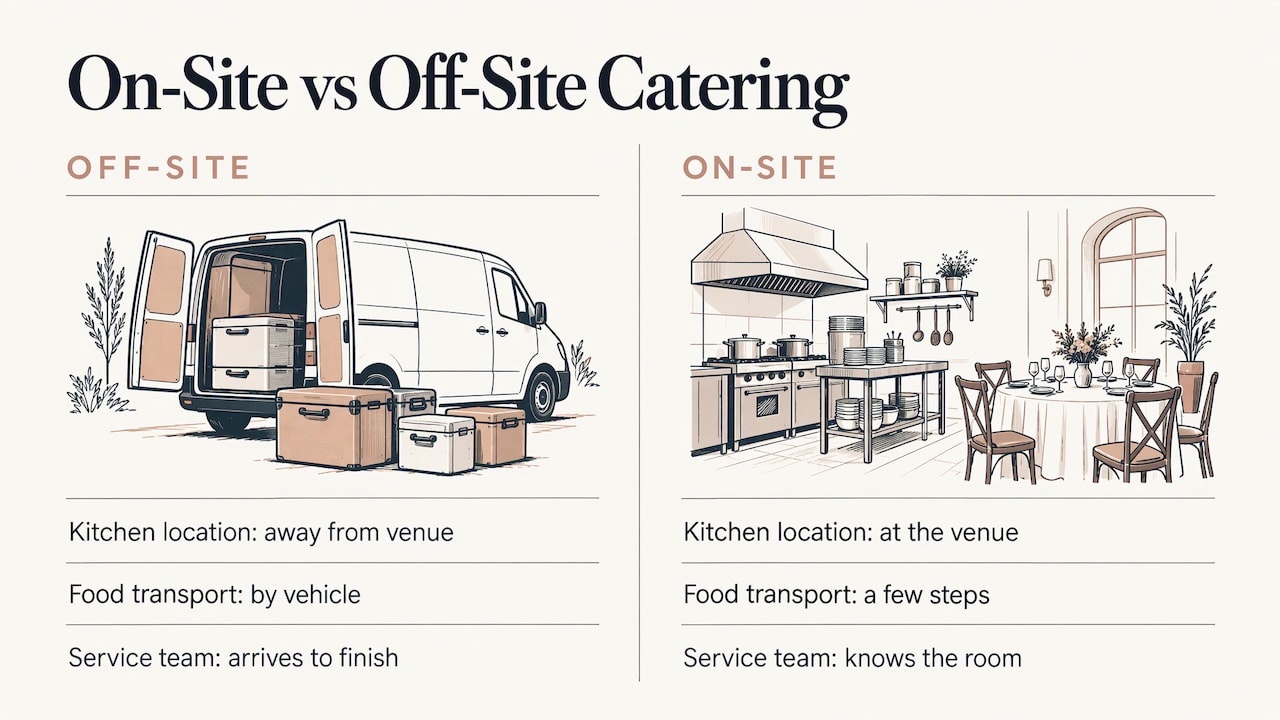
On-site catering turns this around. The kitchen, the bar and the dining space belong to the same place, or the cooking happens right at the venue. Dishes travel a few steps rather than a few kilometers. You may also hear it called on-site event catering, in-house catering or venue catering. The idea is the same: the people who feed your guests know the room, its light, its layout and its rhythm.
On-site versus off-site at a glance
| On-site catering | Off-site catering | |
|---|---|---|
| Where the food is made | At the venue | In a separate kitchen, then transported |
| Who you deal with | Usually one team for food, drinks and space | Caterer and venue are often separate |
| Setup | Familiar room, tables and bar already in place | Equipment and tableware brought in |
| Best for | Dinners, parties and receptions at a venue with its own kitchen | Locations with no kitchen at all |
| Main planning task | Choose the menu and fit it to the space | Check access, power, water and transport |
Neither model is better in every case. The right one depends on where your event is. If you have chosen a venue that already runs a kitchen and a bar, on-site catering is the natural fit.
How on-site catering works, step by step
A catering service usually moves through the same phases, whatever the size of the event. A guide to catering services lists them as menu selection, a site survey of the venue, preparation of the dishes, table setup, table service, and cleaning after the event. A supervisor oversees the staff so that kitchen, room and bar follow the different moments of the evening together.
Here is how that looks in practice for a dinner or party in a garden.
- Brief. You share the date, the number of guests, the kind of occasion and the mood you want: relaxed and long, or elegant and structured.
- Menu. You choose dishes, courses and drinks. Ask whether a tasting is possible for larger events.
- Venue walk-through. You decide where tables go, where the bar sits, where guests gather for an aperitif, and what happens if the weather turns.
- Preparation. The kitchen prepares to the timing of the event, so dishes come out when guests are ready for them.
- Setup. Tables, glassware, lighting and any music or décor are arranged before arrival.
- Service. Staff bring courses, refill drinks and keep an eye on the pace.
- Closing. The team clears the space, so you leave without a to-do list.
When the kitchen is part of the venue, steps 4 to 7 are easier to coordinate, because the same people see the whole evening unfold.
Which events suit on-site catering
Almost any gathering that can be hosted at a venue. The most common are:
- Birthdays and anniversaries, from an intimate table to a large garden party.
- Rehearsal dinners, the relaxed evening before a wedding for close family and friends.
- Pre-wedding and post-wedding parties, such as a welcome aperitif or a day-after lunch.
- Weddings and baptisms, when you want the celebration in one place.
- Corporate or group dinners that want a setting more memorable than a meeting room.
One point from wedding planners is worth knowing. A Tuscany wedding food guide argues that couples who give all the events of wedding week to a single supplier can end up overpaying for the small ones and under-personalizing the big one. It is a fair point about scale: match the format to the size of the event. A rehearsal dinner for 25 people and a reception for 150 have different needs, and a venue with a garden that works for both small and large groups can serve the first one very well.
What to settle before you book
Most problems with catering come from things nobody wrote down. Use this checklist with any provider, and keep the answers in your contract or written quote.
Menu and drinks
- Number of courses, portion sizes and the order of service.
- A tasting, if the event is large enough to justify one.
- Wine, cocktails and other bar arrangements, and whether they are included or charged by consumption.
- Timing: when the aperitif starts, when dinner is served, when the cake or dessert comes out.
Dietary needs
- Collect requirements early, when you send the invitations if possible.
- Ask for confirmed vegetarian, vegan and gluten-free options, and for how the kitchen handles allergens. If a guest has a serious allergy, tell the kitchen directly and ask what they will do about it. Do not assume.
Staff and hours
- How many waiters, bar staff and kitchen staff will be there for your guest count.
- When setup begins and breakdown ends, and what overtime costs if the party runs late.
- Who is in charge on the evening and how you reach them.
Money and terms
- What the price includes: food, drinks, tableware, staff, venue use.
- Whether VAT and service charge are included or added.
- The deadline for the final guest number, payment schedule, and cancellation or rescheduling terms.
These points follow the checklist in an Italy event catering guide, and they apply to any caterer. A clear written agreement protects you as much as the caterer.
Hygiene and registration
In Italy, food businesses must be registered. Local rules add detail: the Reggio Emilia regulation, for example, says catering businesses must be registered with the local health authority, source food from registered laboratories and use equipped dishwashing areas. Rules differ from one municipality to another, so you should not assume that one city’s regulation applies elsewhere. It is still a reasonable question for any provider: is the business registered, and how do you manage hygiene and allergens? A professional answers without hesitation.
Why the space matters as much as the menu
A garden is not a conference room. The best catering responds to where it is. An Apulian catering company puts it well in a piece on event venue catering: a masseria in the countryside has completely different needs than an urban rooftop or a conference hall, and good catering adapts to the space and enhances it.
In a garden in the historic center of a town like Ostuni, that means a few practical choices:
- Flow. Place the aperitif where guests arrive, then move to the tables so the room changes naturally during the evening.
- Seating. Mix long shared tables for lively groups with smaller ones for quiet conversations.
- Light and sound. Evening light in the garden does half the decorating. Keep music at a level that lets people talk.
- Weather. Ask in advance how the venue handles wind, heat or rain.
Building an Apulian menu
On-site catering shines when the menu belongs to the place. In Puglia that is easy, because the pantry is generous. Apulia is Italy’s largest producer of olive oil, with five PDO-protected oils, and its fields also give wheat, tomatoes, chickpeas, lentils, broad beans and cheeses such as caciocavallo and burrata.
Some ideas for a menu with a sense of place:
- A standing aperitif with small bites passed on trays, local cheeses and cured meats, and something fresh from the sea.
- Fresh pasta. Orecchiette is the signature shape of Apulia, made from durum wheat flour, water and salt, and often served with cime di rape, the bitter turnip tops. Other classics are ciceri e tria and fava bean puree with wild greens.
- Focaccia, calzoni and burrata for a relaxed, sharing-style meal. One Italian wedding menu guide suggests exactly these for Puglia, along with fresh pasta and local fish.
- Live stations. A fresh pasta station or cooking in front of guests has become a popular way to make a menu feel personal. A 2026 wedding catering trends article mentions both, especially in Apulian settings.
- Seasonal vegetables. A garden setting invites dishes built on what is in season.
A menu can also tell a story: a dish from a grandmother’s kitchen, a recipe from the couple’s town, a drink that recalls a first trip together. Share these details with the kitchen. They are what turns a good dinner into one guests talk about afterward.
Perspective
We run a restaurant, bar and pizzeria in a garden in the historic center of Ostuni, so we think about on-site catering from the inside. The kitchen, the bar and the garden are not three separate things for us. They are one place, and every event we host is shaped by that.
What we believe is simple. The food should taste of Puglia, the space should feel relaxed, and the event should be adapted to the people, not the other way around. Our garden welcomes small and large gatherings with ease, which is why we host everything from a quiet anniversary dinner to a rehearsal dinner or a pre-wedding party.
When you plan with us, you plan with the people who will actually serve your guests. We offer catering and event planning on site, and we talk through the menu, the flow of the evening and the details that matter to you. The goal is a celebration that feels like our urban vegetable plot: rooted in tradition, warm, and a little modern.
Michele
Plan your event with us
If you are looking for a place where the food, the drinks and the setting come together, we would love to host you. Orto Urbano Ostuni welcomes birthdays, anniversaries, weddings, pre-wedding parties, rehearsal dinners and baptisms, and offers on-site catering and event planning for private celebrations.

Tell us the date, the number of guests and the atmosphere you imagine, and we will shape the evening around it. Explore our private events page to start planning, or see our food and drinks to get a sense of the Apulian menu. Book Now and let us take care of the table.
Questions people ask about on-site catering
What is on-site catering?
It is food and drink service prepared and served at the place where the event happens, rather than made elsewhere and delivered. The kitchen team, the service staff and the setup of the room are planned together, which makes timing and coordination easier.
What is the difference between on-site and off-site catering?
Off-site catering is prepared away from the serving location and transported there, which is how Italian municipal rules describe catering for weddings, baptisms and similar occasions. On-site catering is produced at the venue, so dishes reach the table after a very short journey and one team usually handles both food and space.
Can on-site catering work for a rehearsal dinner or pre-wedding party?
Yes. These are smaller, more informal events, and they suit a venue that can serve a relaxed menu in a garden or similar setting. Share your guest count, dietary needs and preferred style early so the menu and the layout can be set up properly.
What should I confirm with a caterer before booking?
Ask for the menu and what the price includes, the final guest-number deadline, staffing and hours, VAT and service charge, and cancellation terms. Ask also about allergen handling and the business’s registration. Put all of this in writing.
How early should I plan?
Start as soon as you have a date and a rough guest count, especially for weddings and peak-season weekends. Menus, tastings and dietary requests take time, and an early conversation leaves room to adjust.